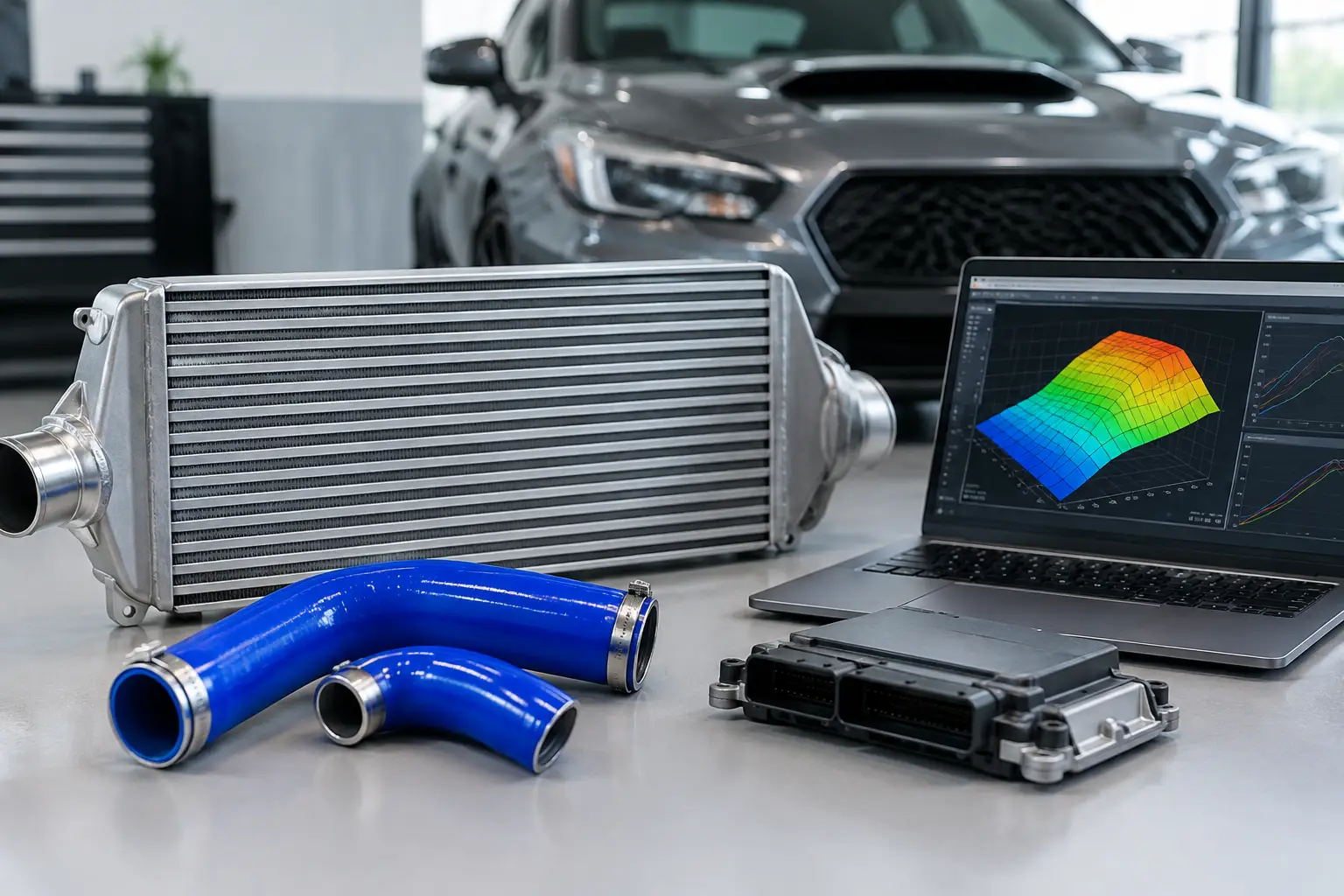
What an Intercooler Upgrade ECU Tune Changes

A performance car that feels strong for one acceleration run but less consistent after repeated use is often managing heat, not lacking potential. An intercooler upgrade ECU tune addresses that relationship by pairing improved charge-air cooling with ECU calibration that recognizes the vehicle's revised hardware. The objective is not simply a larger peak figure. It is more stable response, more controlled power delivery, and drivability that remains composed in everyday conditions.
For premium and high-performance vehicles on the Costa del Sol, ambient temperature and sustained driving can make this especially relevant. A well-matched setup should help the car feel predictable whether it is moving through town, joining the highway, or being driven more purposefully on a suitable private road or track environment.
Why Intake Temperature Affects How a Car Drives
Turbocharged engines compress intake air before it reaches the engine. Compression produces heat, and hot air is less dense than cooler air. It can also increase the likelihood of combustion conditions the ECU needs to protect against. The intercooler sits between the turbocharger and the engine, reducing the temperature of that compressed air before it enters the intake system.
The factory intercooler is designed around the vehicle's original output, expected climate range, packaging restrictions, and manufacturer durability requirements. It may perform well in normal driving, yet approach its thermal limits during repeated acceleration, high ambient temperatures, or when the engine is operating above its original load targets.
When intake temperatures rise, the ECU may reduce ignition advance, boost pressure, or torque request to protect the engine. The driver experiences this as a car that feels less immediate or less consistent after a period of hard use. This protective behavior is appropriate. The question is whether the hardware and calibration still give the ECU enough thermal margin for the way the vehicle is actually used.
What an Intercooler Upgrade Changes
A larger or more efficient intercooler can reduce charge-air temperatures and slow the rate at which those temperatures rise under load. That can give the calibration more stable operating conditions, particularly through repeated acceleration. It does not make heat disappear, and results depend on intercooler design, airflow through the vehicle, turbocharger efficiency, ambient conditions, fuel quality, and driving pattern.
Intercooler selection is not only about core size. Internal flow design, pressure drop, pipework fitment, heat-exchanger placement, and the vehicle's cooling package all matter. An oversized component with poor airflow or excessive restriction may not deliver the improvement its dimensions suggest. On some vehicles, installation access and the quality of associated hoses and clamps deserve as much attention as the intercooler itself.
A hardware upgrade also changes the context in which the ECU operates. If it allows cooler, denser air to reach the engine more consistently, the software should be reviewed rather than treated as separate work. This is where an intercooler upgrade ECU tune becomes an engineering exercise rather than a parts installation followed by a generic file.
How ECU Calibration Is Adapted to the Hardware
The ECU does far more than request boost. It coordinates air mass, fuel delivery, ignition timing, torque limits, temperature protections, throttle behavior, and communication with other vehicle systems. On many modern performance vehicles, the gearbox calibration also influences how available torque is delivered and managed.
After an intercooler upgrade, a suitable ECU calibration begins by confirming what has actually changed. The relevant questions include the intercooler specification, intake and exhaust configuration, turbocharger hardware, fuel used, current software status, and the driver's objectives. A car with an intercooler alone may require a different approach from one with several compatible performance modifications.
For an eligible vehicle in standard configuration, proven performance software may be the appropriate route. Where the hardware configuration has changed, Advanced Performance Software or Tailor-Made Calibration can account for the complete setup. The latter is developed around the individual vehicle, its hardware, fuel, measured driving data, and the response the driver wants from the car.
The goal is balanced calibration. Cooler intake air can support more consistent performance, but the correct settings remain dependent on measured data and safe operating margins. A responsible calibration retains the ECU's protection strategies and avoids chasing a headline number at the expense of refinement, component life, or repeatability.
The Assessment Comes Before the Installation
Before recommending software for a modified vehicle, REVENTO starts with a technical assessment and diagnostics. This establishes a reliable baseline and identifies issues that could compromise the result, such as stored fault codes, boost leaks, sensor deviations, ignition concerns, or cooling-system problems. An intercooler cannot compensate for an underlying mechanical fault.
The ECU is then identified to determine its current software condition and available calibration path. Some ECUs require unlocking before programming can proceed, while others can be accessed directly. Unlocking is assessed by vehicle and ECU type, and certain units may require off-site work. This is confirmed before an appointment is planned, not discovered halfway through the process.
With the hardware configuration verified, the calibration can be selected or developed appropriately. Checksum validation is part of the programming process, helping ensure the software data is correctly written and recognized by the ECU. Where the vehicle and application warrant it, data logging can be used to review key operating behavior under controlled conditions, including intake temperature trends, boost behavior, ignition correction, and requested versus delivered torque.
Validation matters because a vehicle can feel faster while still having an unresolved issue. The final check should focus on the quality of delivery: clean response, predictable throttle behavior, consistent acceleration, and no warning lights or fault conditions related to the work. If a TCU or gearbox calibration is relevant, it should be considered as part of the complete torque-management strategy rather than as an automatic addition.
When an Intercooler Upgrade Makes Sense
An intercooler upgrade is often worth considering when a turbocharged vehicle is used in warm weather, makes repeated pulls, has compatible airflow modifications, or has shown a noticeable drop in consistency after heat builds. It can also be a sensible supporting modification for an owner who wants a more developed calibration without compromising the vehicle's everyday character.
It is not automatically the first modification every vehicle needs. A standard vehicle driven gently in moderate conditions may gain little practical benefit from changing the intercooler alone. Some factory cooling systems are already capable for the intended use, while others may benefit more from addressing maintenance, tires, brakes, or suspension before increasing engine output.
There are trade-offs to consider. Parts and installation quality vary considerably, and a modification may affect warranty considerations or require verification against local regulations and emissions requirements. The best choice depends on the car, its condition, the intended use, and the owner's priorities. Clear advice should include reasons not to proceed, where that is the more sensible decision.
A Better Result Comes From the Complete Picture
The most satisfying modified vehicles do not feel dramatic only at full throttle. They feel deliberate in normal driving: responsive when requested, smooth when cruising, and consistent when conditions become demanding. That is what an intercooler and calibration should work toward together.
Share your vehicle details, current hardware, fuel preference, and driving objectives before choosing a path. A proper technical assessment can establish whether an intercooler upgrade, ECU calibration, or a different improvement will deliver the response you want. ENGINEERED TO PERFORM means making that decision from data and vehicle-specific understanding, not assumptions.


Comments