Data Logging for ECU Tuning: What It Reveals

A calibration file can look correct on paper and still need refinement in the vehicle. Data logging for ECU tuning is the process that replaces assumptions with measured evidence: how the engine, transmission, air system, fuel system, and control strategies behave when the car is driven under relevant load.
For a premium or high-performance vehicle, that distinction matters. The goal is not simply a stronger peak figure. It is clean response when you ask for power, predictable delivery through the rev range, controlled temperatures, and drivability that remains composed in everyday traffic. Logging helps establish whether the vehicle is ready for calibration, whether the calibration is behaving as intended, and whether a more individual approach is appropriate.
What data logging for ECU tuning actually does
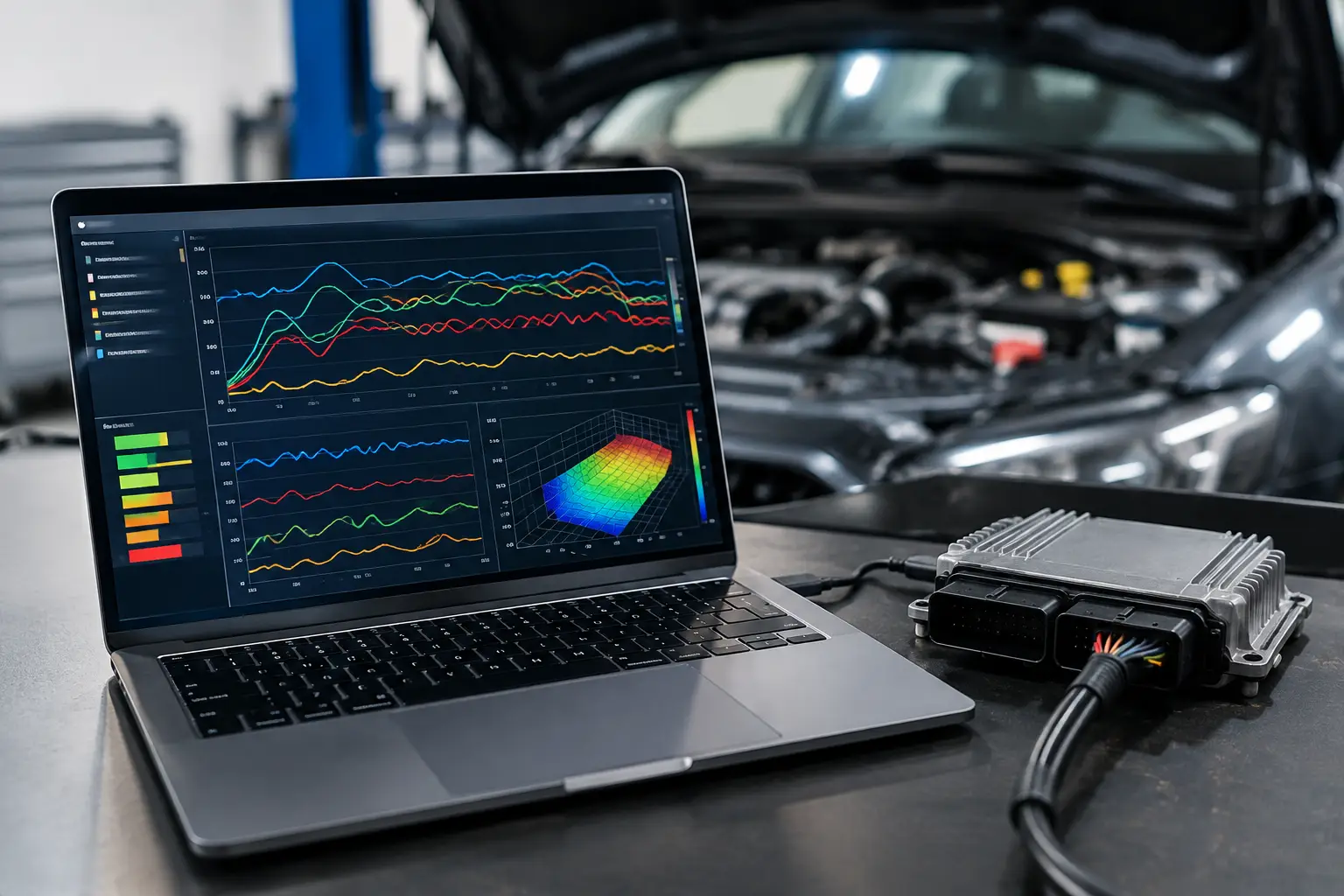
The ECU continuously receives information from sensors and calculates how to operate the engine. A diagnostic log records selected live parameters while the vehicle is running. Depending on the vehicle and the work being carried out, this can include boost pressure, intake-air temperature, ignition timing, fuel pressure, air-fuel targets, throttle position, engine speed, torque requests, wastegate or actuator control, and transmission-related values.
A single value rarely tells the full story. A boost reading may appear acceptable, for example, but the supporting information can show that intake temperatures rise too quickly, fuel pressure does not follow demand as expected, or the ECU is reducing torque to protect the powertrain. The relationship between channels is where the useful diagnosis begins.
This is especially relevant on modern turbocharged vehicles, where the ECU and TCU coordinate torque delivery closely. A calibration should work with the vehicle’s control systems, not force a result at the expense of consistency or refinement. Measured logs allow the calibrator to see what the car is actually doing rather than what its specification suggests it should do.
Why measured driving data matters
Two cars of the same model can behave differently. Mileage, maintenance history, climate, fuel quality, production changes, software versions, and hardware condition all influence the result. On the Costa del Sol, ambient temperature can also make a meaningful difference to intake temperatures and sustained performance, particularly during warmer months.
For a standard, eligible vehicle, data logging may confirm that the engine is healthy and responding properly to proven performance software. This path is appropriate when the vehicle configuration is known, diagnostics are clear, and the owner’s objective is a well-balanced improvement in response and usable performance.
For a vehicle with a revised intake, exhaust, intercooler, turbocharger-related hardware, fuel-system changes, or other compatible modifications, the need for measured data becomes more significant. Parts do not automatically work together as a package. Their behavior must be assessed in the context of the engine’s airflow, fuel delivery, temperature control, and torque-management strategies. In these cases, tailor-made calibration is developed around the actual hardware configuration, available fuel, driving data, and the driver’s priorities.
It also depends on how the vehicle will be used. A car primarily driven on short urban journeys has different thermal patterns from one used for long-distance travel or occasional closed-course driving. The calibration strategy should reflect that reality.
The process starts before software is installed
Data logging is not a substitute for proper diagnostics. Before calibration work begins, the vehicle should be assessed for stored fault codes, sensor plausibility, service concerns, fluid condition where relevant, and signs of underlying mechanical issues. A log is most valuable when the baseline vehicle is understood.
ECU identification is part of this initial process. It confirms the control unit type, current software information, and the appropriate method for reading and writing the calibration. Some ECUs require unlocking before programming can proceed, and the method is assessed individually. Certain units may require off-site unlocking rather than workshop or mobile work.
Once the vehicle is confirmed as suitable, baseline data provides a reference point. This helps distinguish a true calibration-related change from an existing characteristic of the car. It is also a useful safeguard: if a concern appears later, there is evidence of how the vehicle performed before any adjustment was made.
How a useful log is collected
A meaningful log needs a repeatable, safe test condition. Random snapshots during light traffic rarely reveal how the engine behaves under the loads that matter. The appropriate route, gear, engine-speed range, and throttle application depend on the vehicle, transmission, and parameters being evaluated.
The objective is controlled measurement, not aggressive road driving. Where road conditions do not allow a safe and legal test, another validation approach may be required. The important point is that the data represents the operating conditions the calibration must manage.
Good logging also requires restraint in interpretation. Sensor values can fluctuate, and some OEM control strategies intentionally intervene based on temperature, gear, altitude, traction conditions, or component protection. A brief ignition correction, for instance, is not automatically a fault. The question is whether the pattern is repeated, whether it occurs under expected load, and whether it is accompanied by other indicators such as fuel-pressure deviation or rising charge temperatures.
Reading the data as a system
The most valuable calibration decisions come from patterns, not isolated numbers. If requested boost and actual boost differ, the next questions may involve actuator control, intake leaks, charge-air efficiency, exhaust flow, or the ECU’s own torque limitations. If the engine is not achieving its ignition targets, fuel quality, intake temperature, knock control, and airflow may all deserve attention.
Fueling requires the same context. The ECU may command additional fuel for protection at high load, while fuel pressure and injector operation show whether the system is delivering what is requested. On direct-injection engines, both low-side and high-side fuel behavior can be relevant. The appropriate channels vary by platform, which is why a generic logging checklist is less useful than a vehicle-specific plan.
Transmission data can be equally important. On compatible vehicles, gearbox calibration and engine calibration should be considered together. Torque intervention during shifts, clutch protection, shift behavior, and torque reporting can affect how a vehicle feels even when the engine is performing correctly. The best outcome is not the sharpest possible shift in isolation. It is a controlled, confident response that suits the car and its intended use.
Validation after calibration
After software installation, checksum validation confirms the programmed file has been written correctly. The next stage is functional validation: checking for fault codes, confirming normal operation, and reviewing relevant measured data under suitable conditions.
This is where data logging for ECU tuning earns its place in the process. It can verify that requested and actual values are tracking appropriately, that protection strategies are not being triggered unexpectedly, and that the vehicle is delivering its performance in a controlled manner. If the data suggests the hardware, fuel, or operating conditions require a different approach, the calibration can be reviewed based on evidence rather than guesswork.
Not every car needs an extensively iterative development program. A healthy, standard-configured vehicle may be well suited to a proven software solution and straightforward validation. A modified car, an unusual configuration, or a driver with specific requirements may benefit from a more detailed cycle of logging, analysis, and refinement. The right level of work should follow the vehicle, not a preset label.
What the driver feels when the calibration is right
Drivers do not experience a data log directly. They experience the result: cleaner throttle response, more consistent pull through the midrange, smoother torque delivery, and fewer moments where the car feels hesitant or unsettled. In an automatic performance vehicle, they may also notice that engine and transmission behavior feel better matched rather than competing with one another.
Those outcomes are only worthwhile if they remain dependable in normal use. A car should still be pleasant leaving a parking garage, moving through Marbella traffic, or covering a long motorway journey. The engineering challenge is to improve the vehicle’s character without losing the qualities that made it enjoyable in the first place.
REVENTO approaches calibration through assessment, diagnostics, measured validation, and clear advice on the appropriate path for each vehicle. Share the vehicle details, current hardware, fuel normally used, and what you want to improve. The most satisfying result is usually not the most dramatic claim, but a car that responds naturally and repeatedly when you drive it. ENGINEERED TO PERFORM.


Comments